 LUPER
LUPER
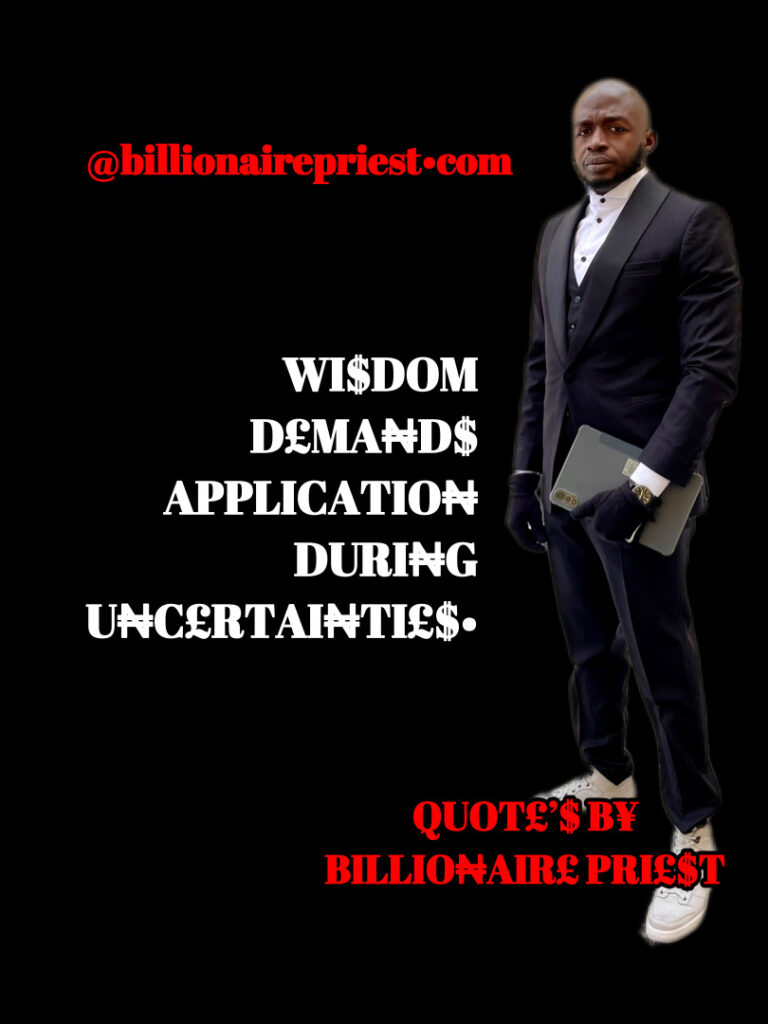
The statement “Wisdom demands application during uncertainties” is a profound reflection on the nature of intelligence, judgment, and action. It emphasizes that true wisdom is not theoretical knowledge but the ability to act correctly when conditions are unclear or unstable. Let’s unpack it deeply.
1. Understanding Wisdom
Wisdom is more than knowledge or experience. It is the ability to:
- Interpret information accurately
- Make sound judgments under pressure
- Balance risks and benefits
- Anticipate consequences
Philosopher Aristotle distinguished between knowledge (episteme), skill (techne), and practical wisdom (phronesis). Practical wisdom is contextual — it shines most when outcomes are uncertain.
2. Uncertainty as the Testing Ground
Uncertainty arises when:
- Information is incomplete
- Situations are volatile
- Outcomes are unpredictable
- Risks are present
In certainty, wisdom is easy to demonstrate. You can follow rules, past patterns, or standard procedures.
Example: Crossing a clear road vs. crossing a busy, chaotic intersection. Knowledge alone is insufficient; judgment in real time determines safety.
Uncertainty is the arena where wisdom proves its value.
3. Knowledge vs. Applied Wisdom
- Knowledge alone is static. You can know many facts but fail to act appropriately when the environment is fluid.
- Applied wisdom is dynamic. It involves decision-making, timing, and adaptability.
Psychologist Daniel Kahneman notes that humans are prone to cognitive biases, especially under uncertainty. Wisdom mitigates these biases through deliberate, reflective, and flexible application.
4. The Courage to Act
Wisdom demands action, not hesitation.
- Uncertainty often triggers fear, indecision, or analysis paralysis.
- Knowledge without action is inert.
- Wisdom combines judgment with courage, executing decisions despite incomplete information.
Ancient Chinese philosopher Sun Tzu emphasized: “Opportunities multiply as they are seized.” Waiting for certainty often means missing the chance entirely.
5. Adaptation and Feedback
Applying wisdom during uncertainty involves:
- Observation: understanding the dynamics of a situation
- Hypothesis: predicting possible outcomes
- Experimentation: taking measured action
- Adjustment: refining approach based on feedback
It is iterative, not linear. The uncertain environment demands flexibility over rigid adherence to rules.
6. Decision-Making Under Risk
Uncertainty is inseparable from risk. Wisdom is not risk avoidance; it is risk management:
- Knowing which risks are tolerable
- Prioritizing actions with asymmetric reward
- Balancing short-term losses against long-term gains
Leaders, investors, and strategists show wisdom when they act decisively in volatile conditions rather than waiting for perfect information.
7. Historical Examples
- Winston Churchill acted decisively during WWII, despite incomplete intelligence and enormous risk, demonstrating applied wisdom.
- Abraham Lincoln navigated the Civil War and abolished slavery by making critical decisions under moral, political, and social uncertainty.
- Entrepreneurs like Elon Musk act in emerging industries with uncertain outcomes, applying calculated judgment that transforms potential into reality.
In all cases, action under uncertainty, guided by wisdom, defined their impact.
8. Wisdom vs. Fear or Complacency
Uncertainty exposes two human tendencies:
- Fear-based inaction: waiting for clarity, often missing opportunity
- Overconfidence or rashness: acting without thought, creating avoidable consequences
Wisdom navigates the middle path: informed, deliberate, courageous, and adaptive action.
9. Internal and External Dimensions
- Internal: Emotional self-regulation, reflection, and mental clarity allow wise decisions in chaos.
- External: Observing the environment, understanding systems, and interpreting social or natural cues guide action.
Wisdom integrates both, transforming uncertainty from paralysis into opportunity.
10. The Core Insight
“Wisdom demands application during uncertainties” teaches:
- Knowledge alone is insufficient; action is required.
- Uncertainty is the true test of wisdom.
- Courage, judgment, and adaptability are inseparable from wise action.
- Inaction under uncertainty is often the greatest failure, while thoughtful application shapes outcomes.
In short: Wisdom is proven not in calm waters but in the storms. It is not what you know but how and when you act under ambiguity that defines its value.