
 LUPER
LUPER
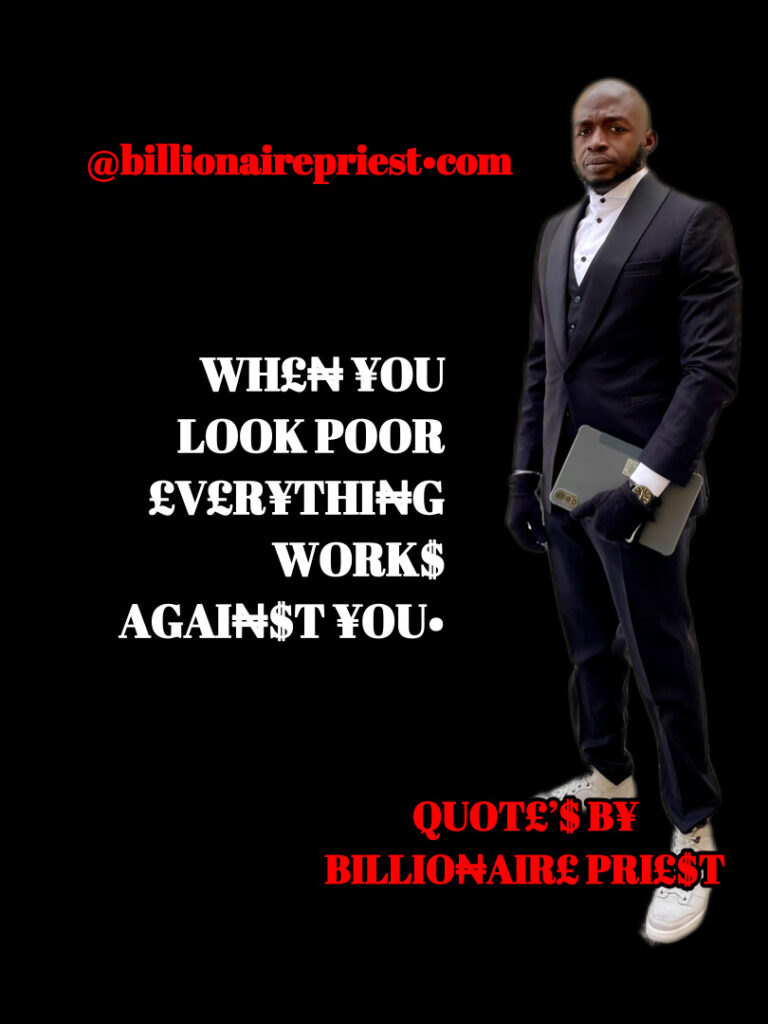
The statement “When you look poor, everything works against you” is less about literal poverty and more about perception, signaling, and systemic bias. It highlights how human judgment and social structures react to appearances of scarcity or low status. Let’s explore this deeply.
1. Perception Shapes Opportunity
Humans often make instant judgments based on appearance:
- Clothing, grooming, posture, and expression are signals of status and competence.
- People associate these signals with reliability, trustworthiness, and capability — sometimes unconsciously.
If someone “looks poor,” they may trigger assumptions like:
“They lack resources, discipline, or influence.”
These assumptions influence access to:
- Jobs
- Credit
- Social networks
- Negotiations
- Opportunities for collaboration
The world is not fair — it reacts to perceived status, not just reality.
2. Appearance as Social Currency
Appearance functions like entry currency in many systems.
- Well-dressed, confident individuals often get the first nod of attention or trust.
- Those perceived as poor must work harder to convince others of competence, even when skill or talent is equal.
Psychologists Amy Cuddy and others have shown that posture, grooming, and presentation influence both how people respond to you and how you feel internally.
3. Bias and Systemic Reinforcement
When you look poor, societal systems often stack disadvantages:
- Economic systems: Banks may reject loans; employers may undervalue applications.
- Social systems: Networks favor those with visible status symbols.
- Cultural perception: People may be treated dismissively or with lower expectations.
This isn’t just about individuals; it’s structural. Systems favor those who project capability, stability, and authority. Appearance becomes a self-reinforcing filter.
4. Psychological Dynamics
Looking poor can affect you internally:
- You may feel less confident and hesitate to assert yourself.
- Others’ subtle cues of dismissal can reinforce insecurity.
- Scarcity thinking dominates decision-making, creating a feedback loop of disadvantage.
Effort alone may not overcome these perception-based obstacles; you must also manage the signal you project.
5. First Impressions Are Hard to Override
Humans make snap judgments in seconds. If initial perception signals scarcity:
- Your ideas may be ignored.
- Your requests may be discounted.
- Your social presence may be undervalued.
Even excellence can be overshadowed by the bias triggered by appearance.
6. Historical and Modern Examples
- Entrepreneurs with polished presentation often secure funding more easily, even if early-stage ideas are similar to less-presentable founders.
- Job candidates with subtle, professional dress codes often get callbacks over equally qualified but casually dressed applicants.
- Political and social leaders frequently curate image to project competence, authority, and influence.
In every case, perception precedes evaluation.
7. Signal vs. Substance
The statement isn’t saying that poverty equals inability. It’s saying:
- Appearance acts as a signal.
- Poor appearance sends a negative signal, which triggers systemic friction.
- Overcoming these barriers requires deliberate effort in both skill and signaling.
You can have competence, but if your appearance undermines your perceived credibility, it adds friction.
8. Strategic Implication
To counteract this bias:
- Manage external signals: clothing, grooming, posture, speech.
- Build credibility rapidly: demonstrate skill and reliability early to offset negative assumptions.
- Leverage networks: connect with people who recognize your value beyond appearance.
- Adapt to system expectations: align signals with norms without losing authenticity.
The goal isn’t vanity — it’s reducing unnecessary barriers caused by perception.
9. The Broader Insight
The phrase reflects a hard truth about human societies:
- Perception often precedes merit.
- Systems are optimized for signals, not only substance.
- Those perceived as poor face structural headwinds.
Understanding this allows you to navigate the system strategically, rather than being passively hindered by bias.
10. Core Lesson
“When you look poor, everything works against you” teaches that:
- Status and perception are powerful forces.
- Effort alone may not suffice; signal and presentation influence outcomes.
- Strategic alignment of appearance with competence can reduce friction and unlock opportunity.
- Ultimately, recognition and respect often require both substance and visible signals of capability.












Hi there! This post couldn’t be written any better!
Reading through this post reminds me of my good old room mate!
He always kept talking about this. I will forward this page to him.
Fairly certain he will have a good read. Many thanks for
sharing!
@visit article Thank you so much for your kind words! 😊That truly means a lot to me. It’s always amazing to hear that something I wrote resonated with someone — especially enough to remind you of your old roommate! He sounds like someone who’s passionate about this topic too. I really appreciate you forwarding it to him, and I hope he enjoys the read as much as you did. Thanks again for taking the time to share your thoughts!