 LUPER
LUPER
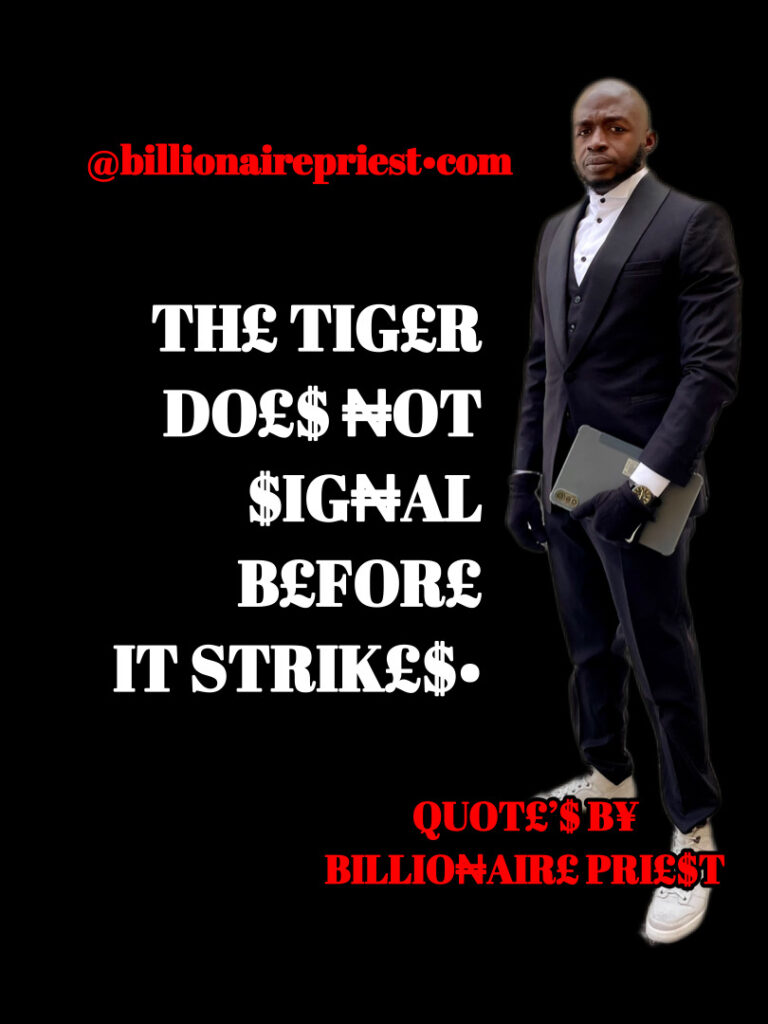
The statement “The tiger does not signal before it strikes” is a metaphor about restraint, strategy, timing, and concealed intent. It contrasts performative aggression with disciplined execution.
It is not about violence. It is about power that moves without announcement.
Let’s examine it deeply.
1. Signaling vs. Acting
To signal is to announce intention:
- Threatening before acting
- Declaring plans prematurely
- Broadcasting ambition
- Displaying aggression to intimidate
In many cases, signaling serves ego more than outcome.
A tiger in the wild survives not because it roars before hunting, but because it:
- Observes quietly
- Conserves energy
- Waits for the right moment
- Moves decisively
The lesson is about efficiency over spectacle.
2. The Psychology of Premature Declaration
When humans announce plans loudly, something subtle happens.
Psychological research shows that declaring intentions publicly can create a premature sense of accomplishment. The brain receives social validation before the work is done.
The motivation dissipates.
Quiet commitment, on the other hand, channels energy inward instead of outward.
Talking about dominance is not dominance.
Talking about discipline is not discipline.
Talking about success is not success.
3. Power Concealed Is Power Preserved
Strategically, revealing intention reduces advantage.
Military theory has long emphasized unpredictability.
For example, Sun Tzu wrote in The Art of War that warfare depends on deception and surprise.
The principle extends beyond battle:
- In negotiation, revealing your full position weakens leverage.
- In competition, showing insecurity invites attack.
- In ambition, public boasting invites resistance.
The tiger does not argue about its strength.
It demonstrates it only when necessary.
4. Silence as Psychological Dominance
When someone moves quietly:
- Others cannot easily predict them.
- Their capacity remains uncertain.
- Their threshold for action is unknown.
Uncertainty creates gravity.
By contrast, constant signaling reveals limits.
When someone threatens repeatedly but never acts, credibility collapses.
Power that must announce itself is fragile.
5. Energy Conservation
Predators in nature conserve energy because every strike carries risk.
Similarly, decisive individuals:
- Choose battles carefully.
- Avoid unnecessary conflict.
- Do not react to every provocation.
Restraint is not weakness.
It is controlled capacity.
The tiger’s silence reflects focus, not passivity.
6. Emotional Regulation
The metaphor also points to emotional discipline.
Reactive people telegraph their triggers:
- They argue quickly.
- They show frustration easily.
- They escalate visibly.
Composed individuals reveal little.
Emotional unpredictability can be chaotic.
Emotional composure can be formidable.
The tiger’s stillness is emotional control embodied.
7. The Strategic Element of Timing
Striking too early wastes opportunity.
Striking too late loses advantage.
Timing requires:
- Observation
- Patience
- Situational awareness
In business, relationships, leadership — those who act at the precise moment often appear effortless.
But that precision comes from waiting without anxiety.
8. The Danger of Over-Signaling
In modern environments, signaling is incentivized:
- Social media rewards announcements.
- Corporate culture rewards visible busyness.
- Competition encourages posturing.
But over-signaling can:
- Alert competitors.
- Invite sabotage.
- Create pressure.
- Drain focus.
Quiet execution reduces noise and preserves clarity.
9. The Deeper Identity Lesson
The tiger does not signal because it does not doubt its ability.
Insecurity seeks witnesses.
Security does not require them.
When identity is stable:
- You do not need to warn others.
- You do not need to prove constantly.
- You do not seek validation before action.
Your results speak.
10. The Refined Interpretation
“The tiger does not signal before it strikes” means:
- Move with intention, not theatrics.
- Announce less. Execute more.
- Let preparation be invisible.
- Let impact be undeniable.
- Conserve energy for decisive moments.
True power is not loud, impulsive, or performative.
It is patient.
It is controlled.
It is precise.