 LUPER
LUPER
This sentence is a moral metaphor about virtue, power, and choice:
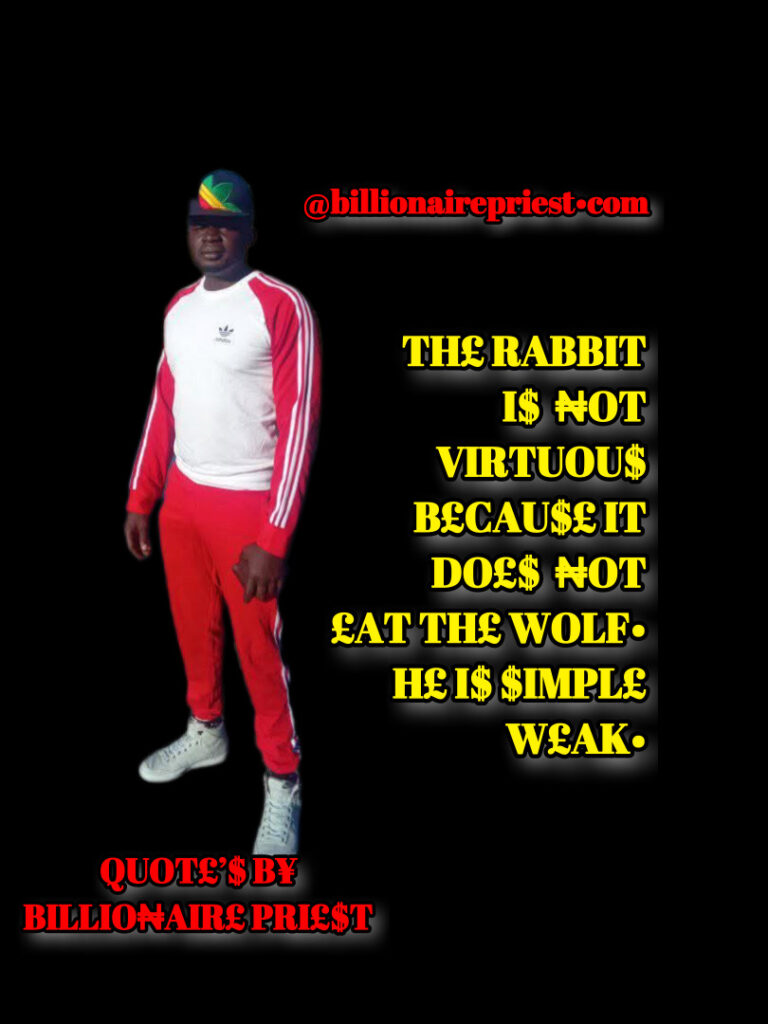
“The rabbit is not virtuous because it does not eat the wolf; it is simply weak.”
It challenges a common misunderstanding of morality: confusing incapacity with virtue.
Let’s explore it deeply.
1. Virtue Requires the Possibility of Doing Wrong
Virtue only exists when a being could do harm but chooses not to.
- A person who could dominate but refrains shows restraint.
- A person who could exploit but refuses shows integrity.
The rabbit does not eat the wolf—not because of moral wisdom, compassion, or restraint—but because it cannot. There is no internal struggle. No ethical decision. No sacrifice.
Without the ability to choose otherwise, there is no virtue—only limitation.
2. Weakness Is Not the Same as Goodness
The metaphor exposes a subtle but important distinction:
- Weakness: “I don’t harm because I am unable.”
- Goodness: “I don’t harm because I choose not to.”
The rabbit’s behavior is dictated by biology and fear, not ethics. Calling this “virtue” is projecting morality onto something that has no power to act differently.
This matters because when weakness is mislabeled as virtue, people may:
- Avoid developing strength
- Fear power as immoral
- Believe passivity equals goodness
That leads to fragility, not morality.
3. Why Strength Gives Moral Weight
Imagine two beings:
- One has no claws, no teeth, no dominance.
- The other has strength, intelligence, and authority.
Only the second one can truly be virtuous, because only they must restrain themselves.
Virtue is not the absence of aggression—it is the mastery of it.
The wolf that chooses not to devour when it could is morally superior to the rabbit that cannot.
4. The Inner “Wolf” Concept
Psychologically, the wolf represents:
- Aggression
- Desire
- Power
- Self-interest
The rabbit represents:
- Fear
- Compliance
- Avoidance
A virtuous person is not one who has no inner wolf, but one who has it and governs it.
Suppressing or denying strength does not make someone good. Integrating it responsibly does.
5. The Danger of Praising Rabbit Morality
If society praises the rabbit as virtuous, it may:
- Teach people to remain harmless rather than capable
- Discourage boundary-setting
- Produce individuals who cannot protect themselves or others
When pressure arrives—conflict, injustice, crisis—rabbit morality collapses. There is no strength to act when action is required.
6. True Virtue Is Voluntary Restraint
The deepest lesson of the metaphor is this:
Virtue is not about what you do not do because you can’t. It’s about what you refuse to do even though you can.
A moral life is not passive. It is disciplined power.
7. The Ideal Balance
The goal is not to become a wolf that devours everything, nor a rabbit that hides from everything.
The ideal is:
- To have strength
- To understand your capacity for harm
- To consciously choose restraint, justice, and compassion
That choice—made freely—is where virtue truly lives.
In summary
The rabbit is innocent, but innocence is not virtue.
Virtue begins where power exists and is wisely restrained.