 LUPER
LUPER
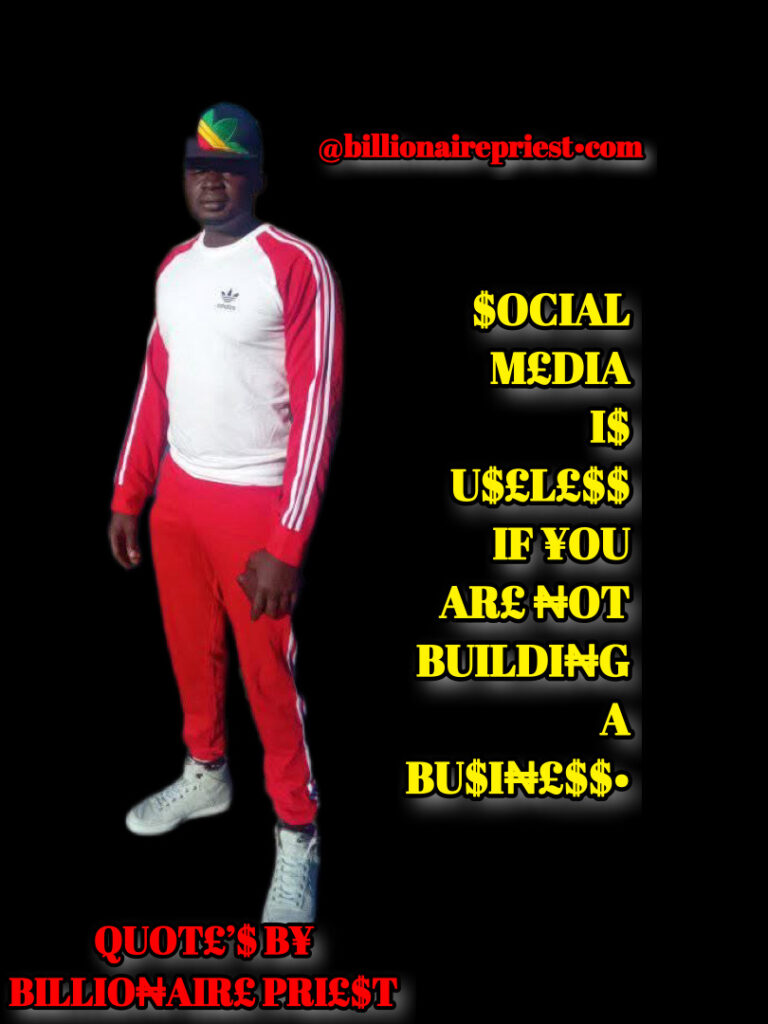
The statement “Social media is useless if you are not building a business” sounds extreme, but it points to a deeper truth about how social media actually creates value. Let’s unpack it carefully and honestly.
1. Social media’s core design is transactional, not communal
Despite the language of “connection,” social media platforms are attention marketplaces. Their real function is to:
- Capture attention
- Monetize that attention (ads, data, influence)
- Reward behavior that keeps people scrolling
If you are not converting attention into something tangible—money, skills, opportunities, leverage—then the platform is converting you instead.
In other words:
- The platform always wins
- The question is whether you extract value too
A business (or business-like goal) is one of the few mechanisms that reverses this flow.
2. Without a business goal, social media consumption becomes value-negative
When you’re not building something, social media tends to produce:
a) Dopamine without progress
Likes, views, and validation trigger short-term dopamine but do not compound.
Nothing meaningful is built. Nothing improves your future position.
Contrast that with a business:
- Content → audience → trust → revenue
- Every post can stack on the previous one
Without that loop, usage is psychological stimulation, not growth.
b) Identity erosion instead of identity construction
On social media, you are constantly exposed to:
- Curated success
- Artificial lifestyles
- Algorithmically amplified extremes
If you are not actively shaping a public identity (expertise, brand, mission), the platform shapes one for you:
- Consumer
- Spectator
- Reactor
A business forces you to define:
- What you stand for
- Who you serve
- Why your voice matters
Without that, you slowly become background noise—even to yourself.
3. Social media rewards producers, punishes consumers
The platforms are asymmetric:
| Producers | Consumers |
|---|---|
| Gain reach | Lose time |
| Build leverage | Build dependency |
| Create assets | Absorb noise |
| Compound influence | Fragment attention |
If you are not building a business, you are almost always in the consumer column.
A business turns posting into:
- Market research
- Distribution
- Sales
- Relationship-building
Without that, scrolling is mostly time extraction.
4. Social media pretends to replace real life—but only for those with leverage
Social media promises:
- Community
- Opportunity
- Expression
But in practice:
- Community requires leadership (often a business)
- Opportunity requires positioning (often a business)
- Expression without purpose becomes shouting into void
People with businesses use social media as:
- A megaphone
- A filter
- A funnel
People without one experience it as:
- Comparison
- Distraction
- Emotional volatility
Same tool. Opposite outcomes.
5. The opportunity cost is the real danger
The biggest issue is not that social media is “bad.”
It’s that it replaces higher-value activities:
- Learning deep skills
- Building real relationships
- Creating long-term assets
- Thinking without interruption
If you are not using social media to accelerate something external to the platform, it quietly consumes time that could have built:
- A business
- A career advantage
- A body of work
- A reputation
That is why it feels empty in hindsight.
6. A “business” doesn’t have to mean a company
Important clarification:
When people say “business,” they really mean value creation with leverage.
This could be:
- A personal brand
- A creative practice
- A newsletter
- A skill-based career
- A cause or movement
- A portfolio that leads to opportunities
The key is:
Are you converting attention into something that compounds outside the platform?
If yes → social media is a tool
If no → social media is a trap
7. The deeper philosophical point
Social media amplifies who you already are.
- If you are building → it accelerates momentum
- If you are drifting → it accelerates drift
A business (or structured goal) gives:
- Direction
- Constraint
- Feedback
- Meaning
Without those, social media becomes noise masquerading as life.
Bottom line
Social media is not useless by default.
It is neutral infrastructure.
But if you are not building something—especially something that creates value—then:
- You are the product
- Your time is the resource
- Your attention is the currency
That’s why, for most people not building a business (or equivalent), social media ends up feeling empty, addictive, and regretful.