 LUPER
LUPER
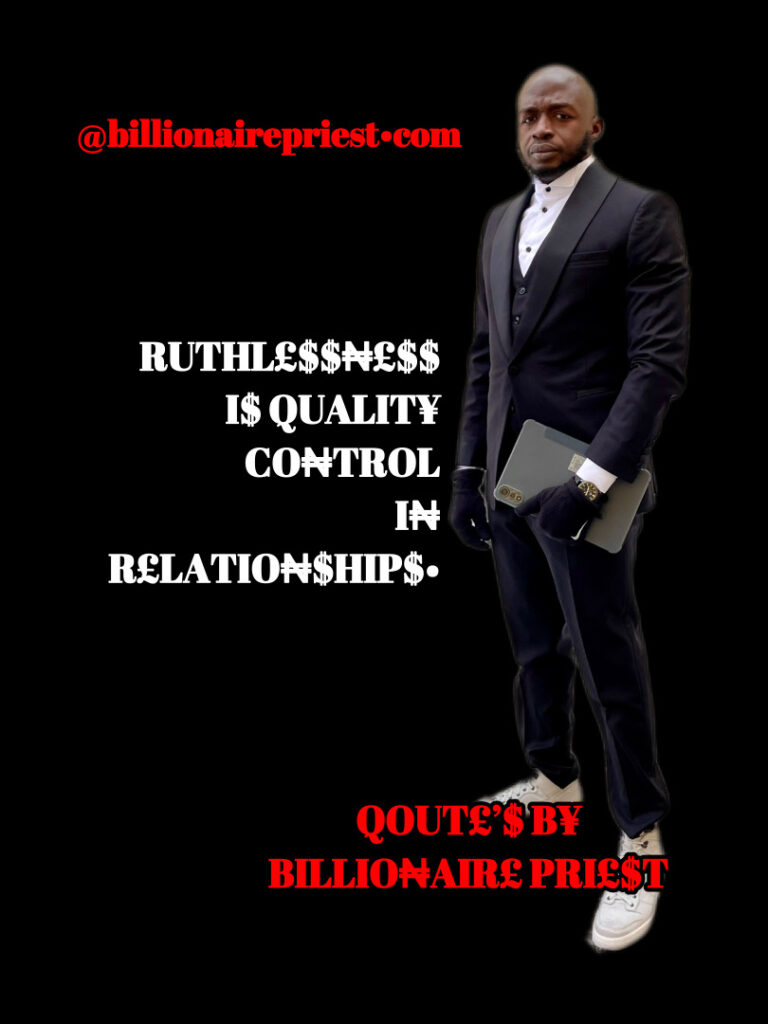
“Ruthlessness is quality control in relationships” is a provocative way of saying:
If you are not willing to cut off what harms you, you will be surrounded by what diminishes you.
But to understand this deeply, we need to separate ruthlessness, discernment, and emotional avoidance — because they look similar on the surface but operate very differently underneath.
1. What “Ruthlessness” Really Means in This Context
In relationships, ruthlessness doesn’t mean cruelty.
It means:
- Non-negotiable standards
- Zero tolerance for repeated disrespect
- Immediate response to red flags
- Willingness to walk away
- No emotional bargaining with bad behavior
It’s the refusal to let comfort override clarity.
Think of it as relational filtration.
Just as a company removes defective products, a person with relational “ruthlessness” removes:
- Chronic liars
- Manipulators
- Boundary violators
- Energy drainers
- Inconsistent partners
The idea is simple:
What you allow repeatedly becomes your environment.
2. Why Most People Struggle With This
Humans are wired for attachment. Psychologist John Bowlby demonstrated that we are biologically driven to maintain connection — even unhealthy ones.
This creates a conflict:
Clarity says: “This is wrong.”
Attachment says: “Don’t lose them.”
Ruthlessness overrides attachment when attachment contradicts self-respect.
That’s difficult.
3. Ruthlessness as Quality Control
Quality control has three parts:
1. Standards
What behaviors are unacceptable?
What values must align?
If you don’t define this, you’ll accept whatever shows up.
2. Inspection
Do words match actions?
Is effort consistent?
Is respect present under stress?
Most people only evaluate when things feel good.
Ruthless evaluation happens especially when things feel intense.
3. Removal
If the pattern doesn’t improve, access is revoked.
No dramatic speeches.
No emotional wars.
Just removal.
That’s the “ruthless” part.
4. The Psychological Power of Detachment
Ruthlessness requires emotional regulation.
If someone:
- Gaslights you
- Tests boundaries
- Repeatedly apologizes without change
The ruthless response isn’t anger.
It’s calm distance.
Psychologists who studied toxic relational cycles, like Lenore E. Walker, observed that patterns repeat when consequences are inconsistent.
Ruthlessness creates consistent consequences.
Behavior that costs access tends to change — or disappear with the person.
5. The Dark Side of Ruthlessness
However, this philosophy can become unhealthy if misapplied.
It becomes destructive when:
- You cut people off at the first imperfection
- You avoid vulnerability
- You confuse discomfort with disrespect
- You use detachment to avoid intimacy
Some people call themselves “ruthless” when they are actually avoidant.
True quality control distinguishes between:
- Human flaw
- Malicious pattern
Everyone makes mistakes.
Not everyone shows character through consistency.
6. Ruthlessness vs Coldness
Coldness:
“I don’t care about anyone.”
Ruthlessness:
“I care about myself enough to protect my peace.”
One is emotional shutdown.
The other is emotional discipline.
Leaders like Steve Jobs were known for ruthless quality standards in business — not because they hated people, but because they refused mediocrity.
In relationships, the same principle applies:
You don’t hate people.
You just refuse emotional mediocrity.
7. Why It Feels So Powerful
When you adopt relational ruthlessness:
- You stop negotiating your worth.
- You stop chasing clarity.
- You stop explaining boundaries repeatedly.
- You stop fearing abandonment.
The energy shift is dramatic.
You move from:
“Please choose me.”
To:
“I will choose what aligns.”
And people respond differently to that.
8. The Deep Balance
The healthiest version of this philosophy is:
Compassionate heart.
Uncompromising standards.
Calm detachment when violated.
Not everyone deserves permanent access.
But not everyone deserves instant removal either.
The real skill is discernment.
Final Insight
Ruthlessness in relationships is not about being hard.
It’s about being clear.
Quality control doesn’t eliminate people because they’re imperfect.
It eliminates patterns that erode dignity.
If you don’t filter your environment, your environment will shape you.