 LUPER
LUPER
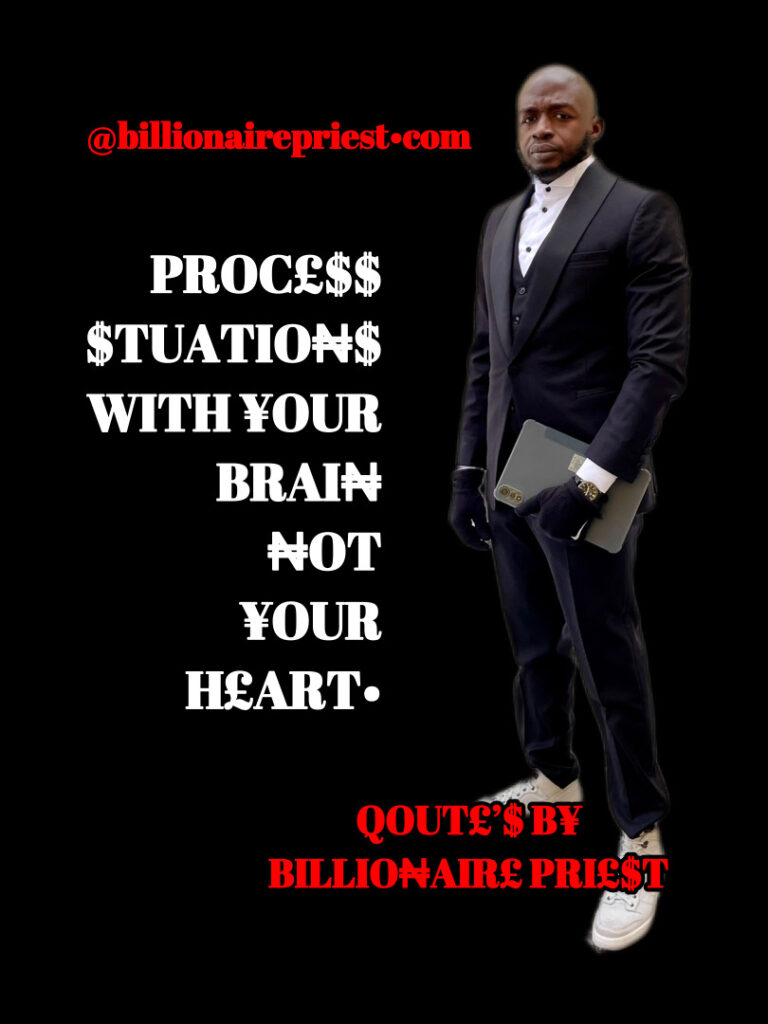
“Process situations with your brain, not your heart” is a metaphorical way of saying: prioritize rational analysis over emotional reaction when making decisions. But to understand it deeply, we have to unpack what “brain” and “heart” really mean.
1. What “Heart” Represents
The “heart” symbolizes:
- Emotions (love, anger, fear, guilt, excitement)
- Empathy and attachment
- Impulses and desires
- Personal biases shaped by past experiences
Emotional processing is fast. It’s automatic. It evolved for survival.
For example:
- You feel insulted → immediate anger.
- You feel lonely → you text someone you shouldn’t.
- You feel guilty → you agree to something you don’t want.
The heart reacts.
It doesn’t calculate long-term consequences.
2. What “Brain” Represents
The “brain” symbolizes:
- Logic
- Critical thinking
- Pattern recognition
- Risk assessment
- Long-term consequence evaluation
- Self-regulation
This is often associated with the prefrontal cortex (the rational, planning part of the brain), which helps override emotional impulses from the limbic system.
The brain asks:
- What are the facts?
- What are the possible outcomes?
- What evidence supports this?
- What is the long-term impact?
- Am I reacting or responding?
3. Why Emotions Can Distort Judgment
Emotions are powerful—but they are not always accurate.
Emotional distortions include:
- Projection: Assuming others feel what you feel.
- Catastrophizing: Turning a small issue into a disaster.
- Confirmation bias: Seeing only what supports your feelings.
- Fear-based avoidance: Avoiding growth because it’s uncomfortable.
For example:
You feel rejected → You assume you’re unworthy → You withdraw → You create more isolation.
The emotion feels real.
But the interpretation may not be accurate.
4. Rational Processing in Practice
Processing with your brain doesn’t mean suppressing emotion.
It means:
- Pause the reaction
- Label the emotion
- Separate fact from feeling
- Evaluate options objectively
- Choose based on values and consequences, not intensity
Example:
Situation: Someone criticizes your work.
Heart reaction:
“They don’t respect me. I’m angry. I’ll shut down.”
Brain processing:
- What exactly did they say?
- Is there truth in it?
- What is their intention?
- What response benefits me long-term?
The difference is control.
5. Emotional Decisions vs Rational Decisions
| Emotional Decision | Rational Decision |
|---|---|
| Immediate | Deliberate |
| Short-term relief | Long-term benefit |
| Driven by intensity | Driven by evidence |
| Often regretful | Usually stable |
Emotional decisions often optimize for how you feel now.
Rational decisions optimize for where you want to be later.
6. When the Heart Is Necessary
This phrase can be misunderstood.
Pure logic without empathy becomes cold and destructive.
Leaders like Nelson Mandela used rational strategy but were deeply guided by compassion.
The goal is not:
- Brain instead of heart.
The goal is:
- Brain leading, heart informing.
Emotion gives data.
Reason decides action.
7. The Ideal Balance
The highest form of intelligence is emotional regulation.
Instead of:
“I feel this, so it’s true.”
Shift to:
“I feel this. Why?”
That pause is power.
Strong individuals:
- Feel deeply
- Think clearly
- Act intentionally
8. Practical Framework for Using Your Brain First
When facing a situation:
- What am I feeling?
- Why am I feeling it?
- What are the objective facts?
- What outcome do I want long-term?
- What action aligns with my principles?
If your action still makes sense after answering those — it’s likely rational.
Final Insight
Processing with your brain instead of your heart doesn’t mean becoming less human.
It means:
- Not being controlled by temporary emotion.
- Not letting fear, anger, or attachment make permanent decisions.
- Choosing response over reaction.
Emotion is energy.
Reason is direction.
Without direction, energy becomes chaos.
With direction, it becomes power.