 LUPER
LUPER
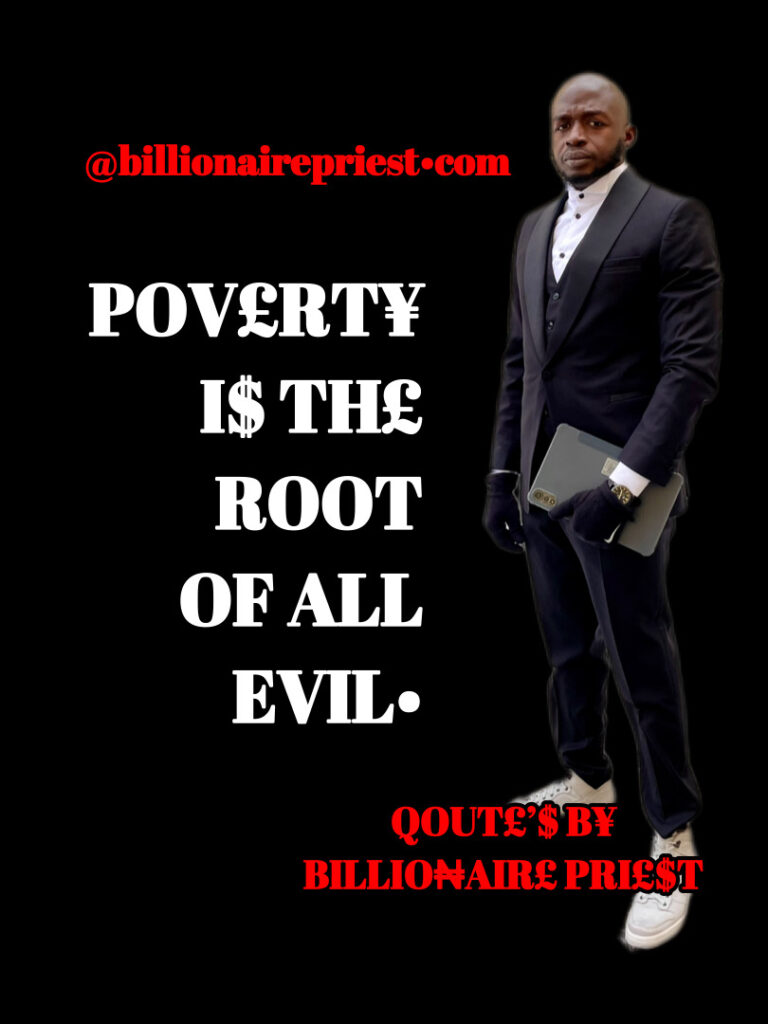
“Poverty is the root of all evil” is a provocative claim. It’s not literally true in every case—but it does point to something very deep about how human behavior, institutions, and morality are shaped by material conditions. Let’s unpack it carefully.
1. Poverty distorts choice before it corrupts character
Evil is often imagined as a moral failure—greed, cruelty, selfishness. But poverty works upstream of morality. When people lack food, shelter, healthcare, education, or security, their range of choices collapses.
- Stealing becomes survival, not vice
- Lying becomes protection, not deception
- Violence becomes defense, not malice
When your basic needs are unmet, moral ideals compete with biological urgency. Hunger, fear, and instability don’t just pressure behavior—they reshape decision-making itself. Neuroscience shows that scarcity narrows cognitive bandwidth, making long-term thinking and empathy harder. Poverty doesn’t excuse harm, but it explains why harm becomes more likely.
In that sense, poverty doesn’t create evil people—it creates conditions where harmful actions are incentivized or unavoidable.
2. Poverty breeds structural violence, not just individual wrongdoing
Much of the world’s “evil” isn’t committed by individuals acting alone—it’s baked into systems.
- Exploitative labor
- Child labor
- Human trafficking
- Crime economies
- Corrupt governance
These flourish where poverty is widespread. When large populations are desperate, power concentrates in the hands of those who control resources. This imbalance enables exploitation at scale.
Importantly, this kind of evil often looks legal, normal, or even efficient. Poverty supplies a steady stream of vulnerable people; institutions then monetize that vulnerability. The result is harm without villains in the traditional sense—just systems that grind people down quietly.
3. Poverty erodes trust, and trust is the foundation of morality
Moral societies depend on trust:
- Trust that effort will be rewarded
- Trust that rules are fair
- Trust that others won’t exploit you
Poverty corrodes all three.
When people repeatedly experience injustice, broken promises, and exclusion, cynicism replaces solidarity. Cooperation gives way to zero-sum thinking: If I don’t take advantage, someone else will.
This is crucial: many moral norms only function when people believe the system itself is moral. Persistent poverty tells people the opposite. Once trust collapses, behaviors we label “evil” often follow—not because people stop caring, but because caring feels dangerous or pointless.
4. Poverty reproduces itself across generations
One of the darkest aspects of poverty is that it limits moral development across time, not just in the present.
Children raised in poverty face:
- Chronic stress
- Lower-quality education
- Exposure to violence
- Fewer positive role models
- Reduced social mobility
These aren’t just disadvantages; they shape personality, impulse control, worldview, and expectations of others. Over generations, this creates cycles where harmful behavior is normalized—not because people are inherently worse, but because alternatives were never made real or credible.
From the outside, this can look like “cultural decay.” From the inside, it’s inherited survival logic.
5. But poverty is not the only root
Here’s the necessary correction: poverty is a root, not the root.
History shows immense evil committed by:
- Wealthy elites
- Powerful states
- Ideologues with abundant resources
Greed, lust for power, tribalism, and ideology can generate evil even in abundance. In fact, wealth without accountability can produce harms just as severe—often on a larger scale.
So a more precise claim would be:
Poverty is the most reliable engine of everyday, widespread, systemic harm.
It explains why evil is common, not why it is absolute.
6. The deeper takeaway
If you take the statement seriously, it implies something radical:
Reducing poverty is not just economic policy—it is moral prevention.
- Fewer crimes
- Less violence
- More trust
- Greater empathy
- Stronger institutions
In that light, fighting poverty isn’t charity. It’s harm reduction at the deepest level. It removes the soil in which many forms of evil grow.
In short
Poverty doesn’t turn people evil.
It corners them.
It narrows them.
It trains them to survive in ways that, from a distance, look like moral failure.
And when millions are cornered at once, society itself begins to act immorally.
That’s why the statement feels true—even when it isn’t perfectly precise.