
 LUPER
LUPER
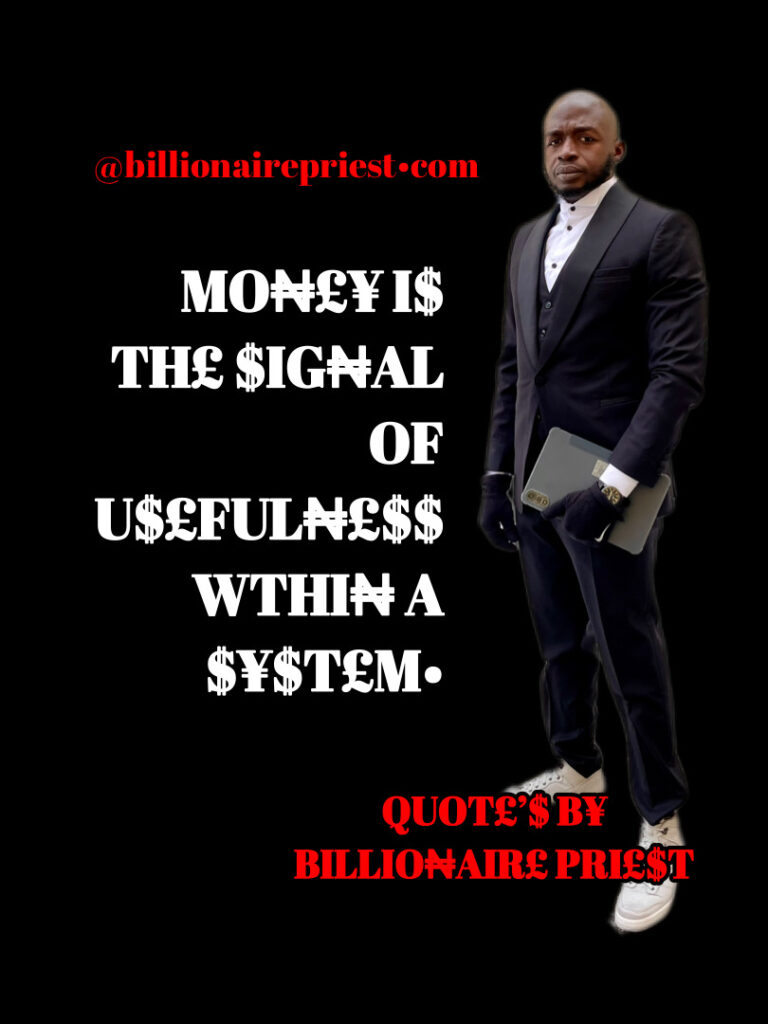
The statement “Money is the signal of usefulness within a system” frames money not merely as currency, but as information — a feedback mechanism that reflects how much a system values what you provide.
To understand it deeply, we need to explore what money really represents, what a “system” is, and what “usefulness” means.
1. Money as Information, Not Just Currency
At its core, money is:
- A medium of exchange
- A store of value
- A unit of account
But beyond economics textbooks, money is also a signal.
Economist Friedrich Hayek argued that prices communicate dispersed information across society. No single person knows all needs, resources, or preferences — but prices coordinate behavior by signaling demand and scarcity.
Money tells you:
- What people want
- How intensely they want it
- How scarce it is
- How efficiently it’s delivered
It is a measurement of value within a given structure.
2. “Usefulness” Is Contextual
Usefulness is not absolute — it is system-dependent.
A brilliant hunter-gatherer in a prehistoric tribe was extremely useful.
That same skill has limited monetary value in a modern urban economy.
Likewise:
- A skilled programmer is highly valued in a digital economy.
- A social media influencer is valued in an attention economy.
- A coal miner was more valuable in the 19th century than today.
Money reflects usefulness relative to:
- The needs of the system
- The structure of the market
- The current technological environment
Sociologist Max Weber noted that economic systems shape what forms of labor are rewarded. Capitalist systems reward scalable productivity and capital efficiency differently than feudal or communal systems did.
Usefulness is not moral worth. It is structural relevance.
3. Systems Define the Game
A “system” can mean:
- A market economy
- A corporation
- A community
- A government structure
- A digital platform
Each system has its own rules of reward.
In a corporate system:
- Usefulness may mean revenue generation or cost reduction.
In academia:
- Usefulness may mean publishing influential research.
On social platforms:
- Usefulness may mean capturing attention.
Money flows toward what the system is designed to amplify.
4. Scarcity × Demand × Leverage
Money often signals usefulness amplified by three forces:
1. Scarcity
How rare is your skill?
2. Demand
How badly does the system need it?
3. Leverage
Can your output scale beyond your time?
Entrepreneurs, investors, and technologists often earn more not because they “work harder,” but because their usefulness scales through systems.
Investor and thinker Naval Ravikant frequently emphasizes leverage — code, media, capital — as tools that multiply output without proportional effort.
Money signals system-level impact, not necessarily effort.
5. The Imperfect Signal
However, money is an imperfect signal.
Some highly useful roles are undercompensated:
- Caregivers
- Teachers
- Parents
- Volunteers
Why? Because usefulness is filtered through:
- Market structures
- Political decisions
- Bargaining power
- Visibility
Money measures what the system is willing and able to reward — not universal human value.
There is a difference between economic usefulness and moral importance.
6. Incentives Shape Behavior
When money signals usefulness, people adapt to the signal.
If the system rewards:
- Attention → people chase visibility
- Speculation → people chase volatility
- Innovation → people chase invention
- Bureaucratic compliance → people chase credentials
The system’s incentive structure gradually shapes identity and aspiration.
As economist Milton Friedman argued, incentives drive behavior. Money is one of the strongest incentive signals in modern societies.
7. The Psychological Dimension
Money also acts as social proof.
High income signals:
- Competence (within that system)
- Market validation
- Negotiation power
- Influence
But this can create confusion:
People may equate wealth with intelligence or virtue, even though money only signals system-specific usefulness.
8. System Dependence and Vulnerability
If money is a signal of usefulness within a system, then wealth can fluctuate when:
- The system changes
- Technology disrupts old skills
- Cultural values shift
- Regulation transforms markets
A skill highly rewarded in one era can collapse in another.
Thus:
Sustainable usefulness requires adaptability.
9. The Deeper Layer
This statement subtly challenges identity.
If your income drops, it may not mean:
- You are less capable.
- You are less intelligent.
- You are less worthy.
It may mean:
- The system no longer values that output at the same rate.
- You are operating in the wrong environment.
- Your skills lack leverage in the current structure.
Money is feedback, not judgment.
10. The Final Synthesis
“Money is the signal of usefulness within a system” means:
- Wealth reflects value recognized by a specific structure.
- Systems reward what advances their priorities.
- Usefulness is contextual, not universal.
- Money measures economic impact, not moral worth.
The deeper wisdom is this:
If you want to increase income, don’t just work harder.
Understand the system.
Understand what it rewards.
Align your skills with scalable demand.
And remember:
Being useful to a system is different from being valuable as a human being.












This site is easy to navigate. I can switch between sports and games easily. A great feature to have!
@flamengo Thank you so much for your kind words! 😊