
 LUPER
LUPER
That statement touches something deeper than friendship.
It’s really about identity, standards, and environment.
Let’s unpack it properly.
1. Growth Is Environmental
No man grows in isolation. Your environment shapes:
- Your habits
- Your standards
- Your beliefs about what’s “normal”
- Your level of ambition
If your closest friends:
- Normalize mediocrity
- Avoid responsibility
- Mock discipline
- Escape through distractions
…you will slowly adapt to that baseline.
Human beings calibrate to their circle.
If everyone around you:
- Complains about money, you’ll justify staying broke.
- Avoids the gym, you’ll skip workouts.
- Laughs at self-improvement, you’ll shrink your ambition.
Not because you’re weak — but because belonging is powerful.
Growth requires friction.
Most friend groups are built around comfort.
2. The Psychology of Identity
Men often stay loyal to friendships that represent an older version of themselves.
Your high school friends might represent:
- The “carefree” you
- The “funny but not serious” you
- The “no big dreams” you
But if you’re trying to become:
- Disciplined
- Financially sharp
- Physically strong
- Purpose-driven
…those identities may clash.
When you start evolving, some friends feel threatened — not because they hate you, but because your growth confronts their stagnation.
Your discipline highlights their excuses.
Instead of rising with you, some will:
- Tease you
- Downplay your goals
- Pull you back into old habits
That’s when distance becomes necessary.
3. Loyalty vs. Alignment
There’s a difference between:
- Being loyal
- Being aligned
Loyalty says:
“We’ve known each other forever.”
Alignment says:
“We are moving in the same direction.”
Time invested is not the same as future compatibility.
You don’t owe your potential to your past.
4. Not All Cutting Off Is Dramatic
Cutting off doesn’t always mean:
- Blocking numbers
- Burning bridges
- Making speeches
Sometimes it simply means:
- Seeing them less
- Not participating in certain activities
- Saying “no” more often
- Protecting your routine
It’s less about rejection and more about priority management.
5. The Cost of Keeping the Wrong Circle
If you stay around people who don’t help you grow, the hidden costs are:
- Lower standards
- Slower progress
- Mental clutter
- Doubt
- Subtle self-sabotage
Comfort is expensive.
And the longer you delay separation, the harder it becomes — because now you’re attached to familiarity.
6. But Here’s the Mature Perspective
Growth isn’t about arrogance.
It’s not:
“I’m better than you.”
It’s:
“I’m serious about who I’m becoming.”
Some friends won’t help you grow — but they aren’t toxic either. They just aren’t aligned with your next level.
And here’s the deeper truth:
You don’t need friends who push you constantly.
You need friends who:
- Respect your discipline
- Support your ambition
- Don’t tempt you to shrink
- Hold you accountable
Silence is fine.
Peace is fine.
Different paths are fine.
Disrespect and regression are not.
7. The Lonely Phase
When a man starts elevating, there is often a season where:
- Old friends fade
- New ones haven’t arrived yet
- Social life shrinks
- Evenings feel quieter
This phase feels uncomfortable — but it’s powerful.
Because solitude builds:
- Self-trust
- Mental toughness
- Vision clarity
Many men quit growth not because it’s hard — but because it gets lonely.
8. The Real Meaning of the Statement
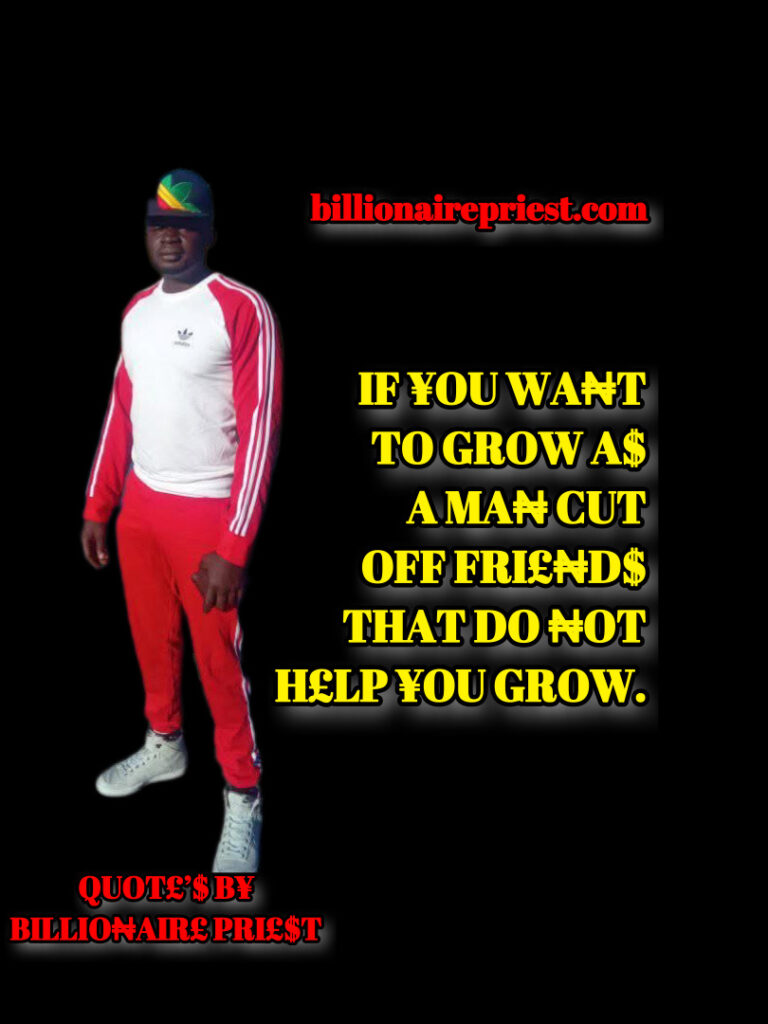
“If you want to grow as a man, cut off friends that do not help you grow” really means:
- Protect your standards.
- Guard your environment.
- Choose alignment over nostalgia.
- Value your future more than comfort.
Growth is selective.
Not everyone can come with you to your next level — and that’s not cruelty.
That’s evolution.












Преодоление личностного роста — это нормальная часть жизни, примите это. Отличная работа, священник-миллиардер! Миру нужно больше таких просветительских идей.
This requires a hardness of heart but it is the only way great work.