 LUPER
LUPER
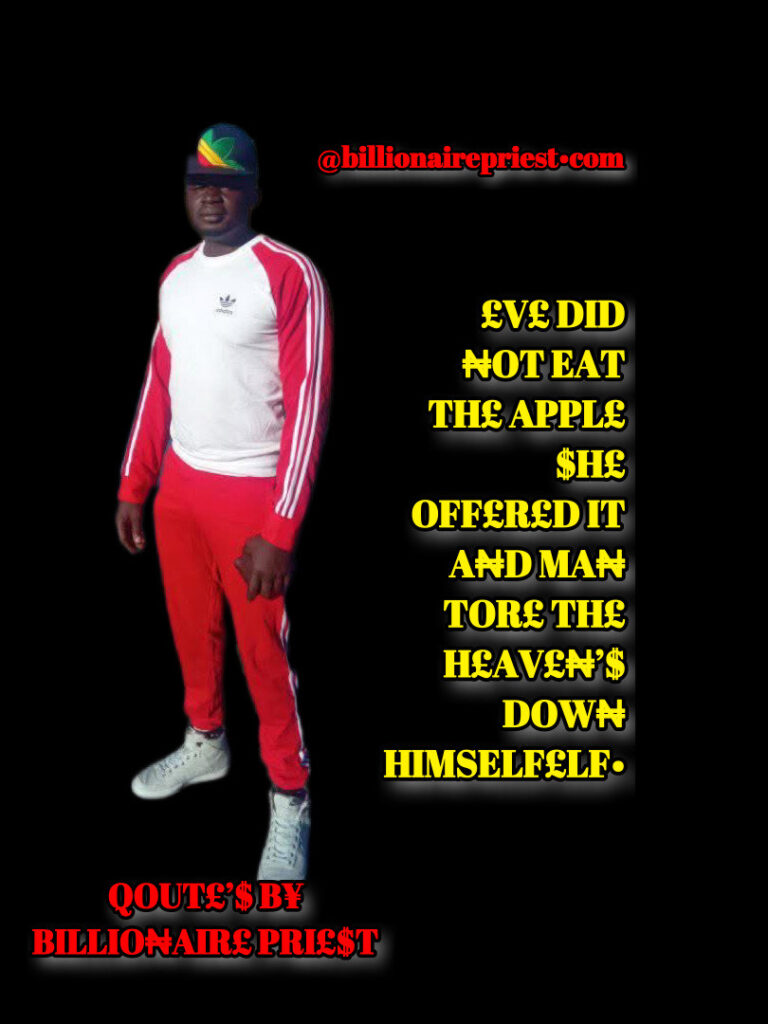
The phrase “Eve did not eat the apple; she offered it and man tore the heavens down himself” seems to be a poetic or metaphorical interpretation of the Biblical story of Adam and Eve from the Book of Genesis in the Bible. To explain this deeply, we need to unpack the symbolism behind the story and how this interpretation differs from the traditional reading of the tale.
1. The Traditional Biblical Story of Adam and Eve
In the Book of Genesis, Eve (the first woman) and Adam (the first man) live in the Garden of Eden, where they are surrounded by everything they need to live happily and without pain. The one rule God gives them is that they should not eat from the “Tree of the Knowledge of Good and Evil,” which is situated in the center of the garden.
However, a serpent (often interpreted as Satan or a symbol of temptation) convinces Eve to eat the fruit from the tree, telling her that it will make her like God, knowing good and evil. Eve then offers the fruit to Adam, who also eats it. After both eat the fruit, their eyes are opened, and they realize that they are naked, feeling shame for the first time. As a result, they are expelled from Eden as a punishment, and humanity is forever marked by the consequences of this “Fall.”
The traditional narrative places the blame squarely on Eve for initiating the action, though Adam is also seen as complicit for choosing to eat the fruit after Eve offered it to him.
2. Interpretation of “Eve did not eat the apple”
This interpretation plays with the idea that Eve’s role in the Fall was not the consumption of the fruit, but the offering of it to Adam. In this view:
- Eve as a symbol of temptation: In many interpretations, Eve is seen as the one who is “tempted” by the serpent. But the statement in the phrase emphasizes that she did not eat the apple for herself in the sense of wanting the forbidden fruit purely for personal gain. Instead, she offers it to Adam, symbolizing that the human (or in some traditions, the feminine) desire to give or share temptation may be what leads to the downfall, rather than an individual act of sin.
- The idea of free will: Eve’s action in offering the fruit might symbolize the human tendency to act on free will, even when faced with consequences. In this case, Eve’s choice, in this interpretation, is not inherently sinful until it’s shared with Adam, showing that once Eve makes her choice, it sets in motion a chain of events that ultimately leads to mankind’s downfall. It could be argued that Eve’s action is not the original sin, but the moment that sets Adam on his own path to destruction.
3. “Man tore the heavens down himself” – Humanity’s Responsibility
This part of the phrase deepens the reflection on the consequences of free will, responsibility, and collective human actions. Here’s how this might be unpacked:
- The role of Adam in the Fall: In the Genesis story, both Eve and Adam are involved in eating the fruit. However, this phrase emphasizes Adam’s action—his choice to eat the fruit and take the consequences of his own free will. The interpretation suggests that while Eve offered the fruit, it was Adam’s choice to eat it that ultimately “tore the heavens down.” This might point to the idea that even though temptation was introduced by Eve, it was Adam’s own decision, as the one who had a direct relationship with God, that resulted in humanity’s separation from God and the destruction of paradise.
- Symbolism of “tearing the heavens down”: The “heavens” in many religious texts, including Christianity, represent the divine order, peace, and harmony between God and creation. The phrase “tearing the heavens down” symbolizes the rupture in the relationship between humanity and God, the loss of innocence, and the beginning of suffering, pain, and mortality. Adam’s choice, in this reading, isn’t just an isolated act of eating fruit—it’s an active decision to break God’s command and to reject divine order, which results in the metaphorical “tearing down” of the perfect, unbroken world they lived in.
- Humanity’s fallibility: The phrase also suggests that the catastrophic consequences of the Fall were a direct result of humanity’s choices, not merely a result of external temptation. While Eve offers the fruit, Adam makes the decisive act of partaking. This interpretation can be read as pointing to the idea that, in the end, the responsibility for the downfall lies in the hands of human beings, not in the external forces (like the serpent or Eve). It suggests a powerful assertion of human free will, and perhaps even an indictment of mankind’s tendency to fall short of the divine ideal.
4. Theological and Philosophical Implications
- Original Sin: In Christian theology, the Fall of Adam and Eve represents the introduction of original sin into the human condition. This original sin is often seen as the reason humanity is inherently flawed, sinful, and separated from God. In the traditional interpretation, both Adam and Eve share responsibility for the Fall, but some interpretations, like the one you’re referring to, place a heavier emphasis on Adam’s active role in bringing about the cosmic consequences.
- The role of temptation and human agency: The phrase highlights the tension between temptation and free will. Eve’s action of offering the fruit represents the external temptation that exists in the world. But it is Adam’s choice to partake in the fruit, symbolizing humanity’s ultimate free will, that brings about the loss of paradise. This reflects a deeper philosophical view: that while external forces may tempt or influence us, it is our own decisions that determine our destiny.
- Human nature and the consequences of choice: The phrase can also speak to the consequences of choice in general. Just as Adam’s decision to eat the fruit led to the downfall of paradise, so too can human choices lead to profound consequences, both good and bad. It’s a reflection on human nature: our capacity to choose, to act with or against divine will, and the ultimate responsibility we have for those actions.
5. Symbolism of the “Apple” and the “Fall”
In Christian tradition, the “apple” (though not actually named in the Bible) has become a symbol of knowledge, temptation, and the transgression of divine law. The fruit from the Tree of Knowledge represents the knowledge of good and evil, a knowledge that leads to the loss of innocence. By eating it, Adam and Eve take on the awareness of their moral choices and the burden of sin.
Thus, the act of “tearing the heavens down” is tied to the idea that the moment Adam eats the fruit, he separates himself from God’s divine protection and order, bringing suffering, death, and alienation into the world.
Conclusion
To summarize, the phrase “Eve did not eat the apple; she offered it and man tore the heavens down himself” emphasizes the idea that while Eve initiated the temptation, it was Adam’s choice to accept it that brought about the catastrophic consequences. It speaks to human agency, free will, and the irreversible consequences of our actions. In this interpretation, the focus is on the responsibility of humanity, particularly in how we respond to temptation, make choices, and face the consequences of those decisions.
This interpretation invites reflection on the deeper meanings of the Fall—beyond the surface-level narrative—and suggests that while we may face external temptations, it is ultimately our own decisions and actions that shape our destiny and our relationship with the divine.