 LUPER
LUPER
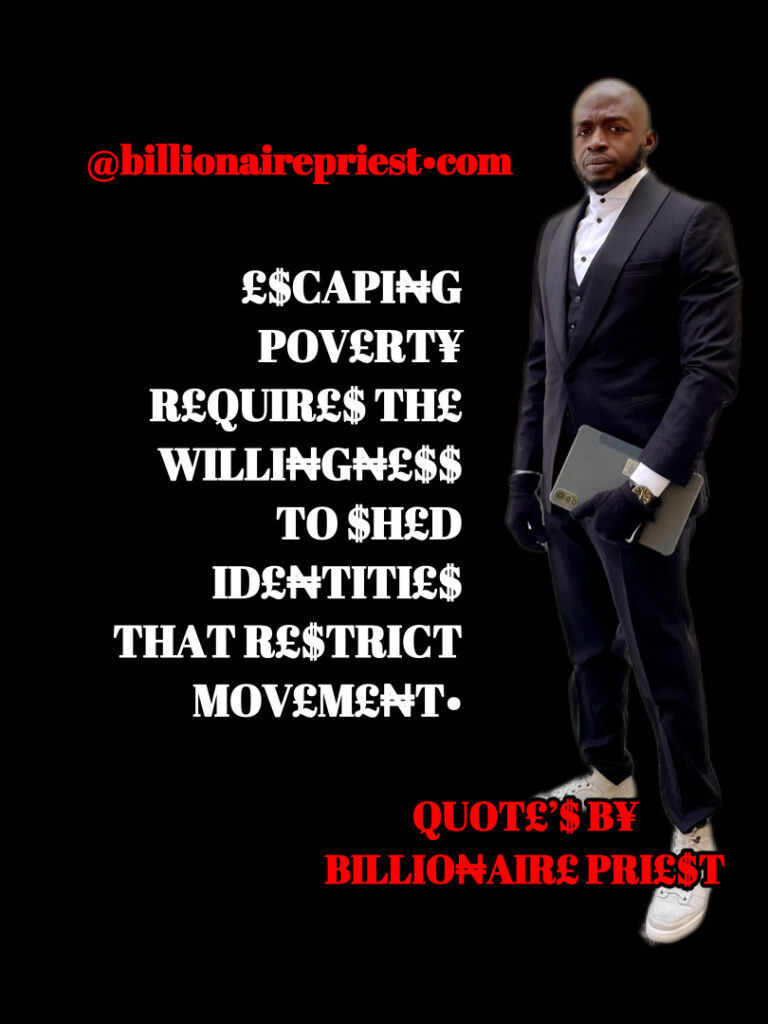
The statement “Escaping poverty requires the willingness to shed identities that restrict movement” suggests that poverty is not only material — it is also psychological, social, and cultural. To understand it deeply, we need to unpack three key ideas: poverty as a system, identity as structure, and movement as transformation.
1. Poverty Is More Than Lack of Money
Poverty is often described as insufficient income. But in reality, it also includes:
- Limited access to education and networks
- Constrained geographic mobility
- Social expectations about “what people like us do”
- Internalized beliefs about possibility
Economists like Amartya Sen describe poverty not just as low income but as lack of capabilities — the reduced freedom to choose and act differently. Poverty narrows imagination before it narrows opportunity.
2. Identity as a Cage (Even When It Feels Like Belonging)
Identity provides meaning and belonging. It can be based on:
- Family background
- Neighborhood
- Class
- Ethnicity
- Gender roles
- Cultural expectations
Sociologist Pierre Bourdieu introduced the idea of habitus — the deeply ingrained habits, tastes, and dispositions shaped by one’s environment. When you grow up in poverty, your “sense of what is normal” is calibrated to survival, not expansion.
Certain identities can become limiting scripts:
- “People like us don’t start businesses.”
- “Higher education is not for people from here.”
- “Success means betraying your roots.”
- “Risk is dangerous because we can’t afford failure.”
These identities protect belonging but restrict mobility.
3. Movement Requires Psychological Risk
To escape poverty often requires:
- Moving geographically
- Entering unfamiliar institutions
- Adopting new speech patterns
- Changing social circles
- Taking risks that peers may avoid
But this creates identity conflict.
Psychologist Claude Steele has shown how identity threat and stereotype pressure can limit performance and ambition. When someone moves into elite spaces, they may feel like an imposter or traitor.
Shedding a restrictive identity doesn’t mean rejecting one’s history — it means refusing to let it dictate future possibility.
4. The Cost of Staying the Same
There is comfort in consistency. Staying within one’s familiar identity:
- Preserves community ties
- Avoids criticism
- Avoids social isolation
But it may also preserve structural limitations.
Escaping poverty often involves a painful trade-off:
Belonging vs. expansion.
Many who “move up” socially describe feelings of loneliness, guilt, or cultural displacement — a phenomenon sometimes called “class straddling.”
5. Shedding vs. Integrating Identity
Importantly, shedding identity does not mean erasing culture, heritage, or pride. Instead, it can mean:
- Letting go of limiting beliefs
- Rewriting inherited narratives
- Expanding one’s sense of what is possible
- Choosing agency over inevitability
The most successful transformations often involve integration rather than abandonment — carrying roots forward while expanding horizons.
6. Why This Is So Difficult
Escaping poverty is hard not only because of economic barriers but because:
- Systems resist mobility
- Communities may resist deviation
- The brain prefers familiarity
- Risk feels more dangerous when you have less cushion
As author James Baldwin once suggested in his broader reflections on identity and society, transformation often requires confronting painful truths about the world and oneself.
Growth requires discomfort. Mobility requires rupture.
7. A Deeper Truth
The statement ultimately points to this:
Poverty persists partly because identity becomes aligned with limitation.
When survival identities (cautious, risk-averse, locally loyal, distrustful of institutions) are necessary in one environment, they may become obstacles in another.
Escaping poverty often demands:
- Expanding identity beyond inherited narratives
- Becoming comfortable being misunderstood
- Tolerating temporary instability
- Choosing long-term mobility over short-term belonging
Final Reflection
Escaping poverty is not just an economic act — it is an identity transition.
It is the willingness to say:
- “I am not confined to what I was born into.”
- “My origins explain me, but they do not define my limits.”
That shift — from inherited identity to self-authored identity — is often the most difficult and most transformative step of all.