 LUPER
LUPER
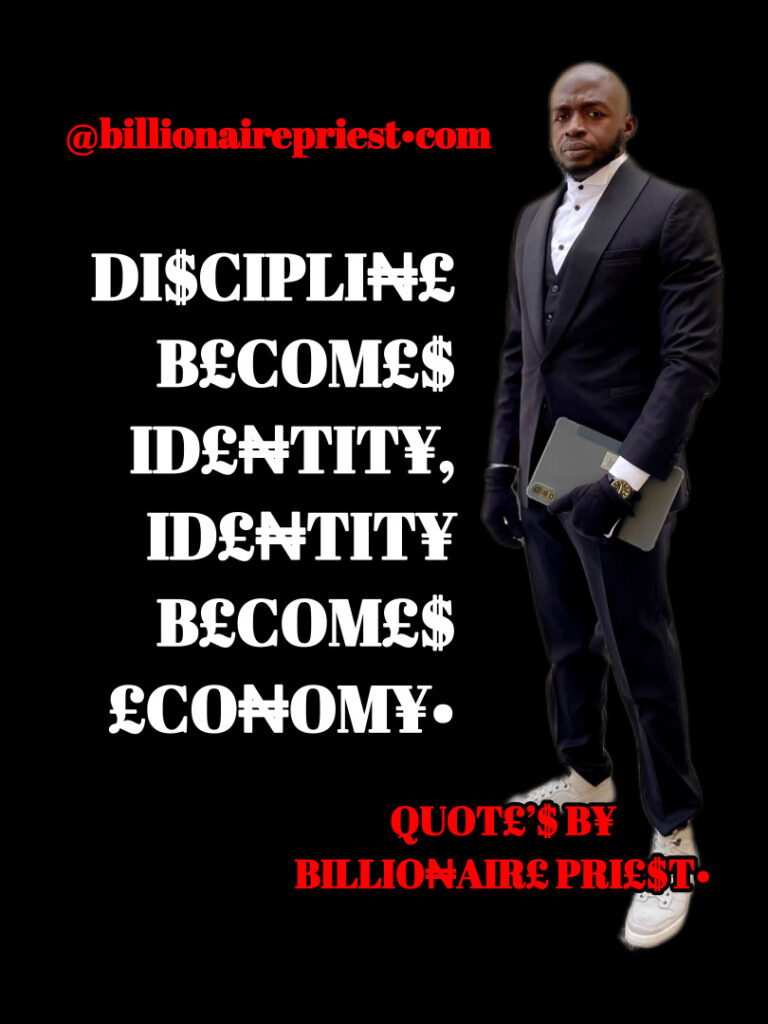
“Discipline becomes identity, identity becomes economy” describes a powerful transformation process—how repeated behavior shapes the self, and how the self eventually generates value in the world.
Let’s unpack it layer by layer.
1️⃣ Discipline → Identity
Discipline is repeated, intentional behavior aligned with a standard.
At first, discipline feels external:
- You wake up early because you decide to.
- You train because you scheduled it.
- You study because you committed to it.
Over time, repetition rewires self-perception.
A person who runs daily doesn’t just “run.”
They become “a runner.”
A person who writes consistently doesn’t just “write.”
They become “a writer.”
This shift mirrors psychological principles popularized by thinkers like William James and later echoed by James Clear:
Behavior repeated consistently becomes self-concept.
Identity forms when:
- Action becomes automatic.
- Effort becomes preference.
- Choice becomes character.
Discipline is the scaffolding. Identity is the structure.
2️⃣ Identity → Economy
Identity changes how the world relates to you.
The market doesn’t reward effort.
It rewards recognized identity and perceived value.
When discipline hardens into identity:
- The disciplined coder becomes “the reliable engineer.”
- The disciplined athlete becomes “the elite performer.”
- The disciplined thinker becomes “the authority.”
And identity compounds.
A strong identity:
- Builds trust.
- Signals predictability.
- Reduces risk for others.
- Attracts opportunity.
This is why consistency often outperforms raw talent economically.
Consider:
- Kobe Bryant — “Mamba mentality” wasn’t just training; it became brand equity.
- Taylor Swift — disciplined songwriting became cultural identity, then global economic power.
- MrBeast — relentless upload discipline became platform dominance and business empire.
Their discipline crystallized into identity.
Their identity scaled into economy.
3️⃣ The Compounding Effect
There are three stages of compounding here:
A. Behavioral Compounding
Small daily actions stack.
B. Reputational Compounding
Others begin to associate you with reliability.
C. Economic Compounding
Opportunities, leverage, and capital multiply.
Once identity is established:
- People pay for access to it.
- Institutions invest in it.
- Networks amplify it.
Economy is essentially organized trust.
Identity is concentrated trust.
4️⃣ The Dark Side
This progression has a shadow.
If discipline forms negative patterns:
- Chronic distraction → “I’m unfocused.”
- Avoidance → “I’m not capable.”
- Inconsistency → “I don’t follow through.”
Identity still forms.
Economy still follows.
The world rewards whatever identity you reinforce—positive or negative.
5️⃣ The Deeper Philosophy
This idea touches existential philosophy:
- We are not what we intend.
- We are what we repeatedly do.
- And the world prices us accordingly.
Discipline is private.
Identity is social.
Economy is systemic.
It’s a ladder:
- Control yourself.
- Become someone.
- Create value.
6️⃣ The Strategic Implication
If you understand this chain, the question changes from:
“How do I make money?”
to
“What disciplined behavior am I willing to practice until it becomes who I am?”
Because once identity solidifies, money becomes a byproduct of alignment between:
- Skill
- Reputation
- Market need
Economy flows toward stable identities with consistent output.
In One Sentence
Discipline is self-directed repetition.
Identity is internalized repetition.
Economy is monetized identity.