
 LUPER
LUPER
“Be valuable to connect, but guarded enough to survive” is a principle about strategic openness — how to participate in the world without being consumed by it.
Let’s unpack it deeply.
1. The Human Paradox: We Need People — and Protection
Humans are wired for connection. Cooperation built civilizations. Trust builds families, businesses, and institutions. But history also shows exploitation, betrayal, and power imbalances.
This creates a paradox:
- If you are too open, you become vulnerable to manipulation.
- If you are too guarded, you become isolated and stagnant.
- The art of living is managing both.
The statement is about mastering that tension.
2. “Be Valuable to Connect”
Connection is not just about being available — it’s about being worth connecting with.
Value can mean:
- Intellectual value (knowledge, insight, clarity)
- Emotional value (empathy, stability, warmth)
- Strategic value (resources, influence, networks)
- Moral value (integrity, reliability, consistency)
When you are valuable:
- People respect your time.
- Opportunities flow toward you.
- Your presence has weight.
Value creates leverage. It prevents you from being disposable.
But value alone is not enough.
3. The Danger of Unprotected Value
The more valuable you become, the more you attract attention — including from:
- Opportunists
- Manipulators
- Energy drainers
- Competitors disguised as allies
If you are valuable but naïve, you become a resource others extract from.
This is where the second half becomes critical.
4. “Guarded Enough to Survive”
Being guarded does not mean being cold or paranoid. It means having:
- Boundaries (what you will and won’t tolerate)
- Discernment (who deserves access)
- Emotional regulation (not reacting impulsively)
- Strategic withholding (not revealing everything)
Guarding is about controlling access.
Not everyone deserves:
- Your vulnerability
- Your plans
- Your inner doubts
- Your full capabilities
Survival in social systems depends on selective transparency.
5. The Balance: Open Hands, Locked Vault
Imagine this structure:
- Your skills and value are your storefront.
- Your mind and strategy are your vault.
You make the storefront inviting.
You keep the vault protected.
The strongest people:
- Share generously.
- Reveal selectively.
- Trust slowly.
- Observe constantly.
They are warm — but not easily penetrated.
6. Psychological Depth
This principle reflects emotional maturity.
Childhood:
- Over-trust.
- No boundaries.
- High emotional exposure.
Trauma reaction:
- Over-guarded.
- Closed off.
- Distrustful of everyone.
Maturity:
- Open, but discerning.
- Kind, but firm.
- Engaged, but self-contained.
It is not about fear.
It is about calibrated trust.
7. Strategic Implications in Different Domains
In Business
Be collaborative — but protect contracts, equity, IP, and information flow.
In Relationships
Be loving — but maintain self-respect and independence.
In Leadership
Be accessible — but never lose authority or emotional composure.
In Power Structures
The visible layer builds alliances.
The hidden layer ensures survival.
8. The Core Truth
If you are only guarded, you survive but never expand.
If you are only valuable and open, you expand but risk collapse.
Sustainable growth requires both.
It is the difference between:
- Naïve kindness and wise kindness.
- Transparency and strategic transparency.
- Generosity and controlled generosity.
9. The Deeper Philosophy
This statement ultimately speaks to sovereignty.
To be sovereign:
- You must create value.
- You must control access to that value.
- You must decide who gets proximity.
Connection is power.
Access is currency.
Boundaries are defense.
Mastering all three is survival with influence.
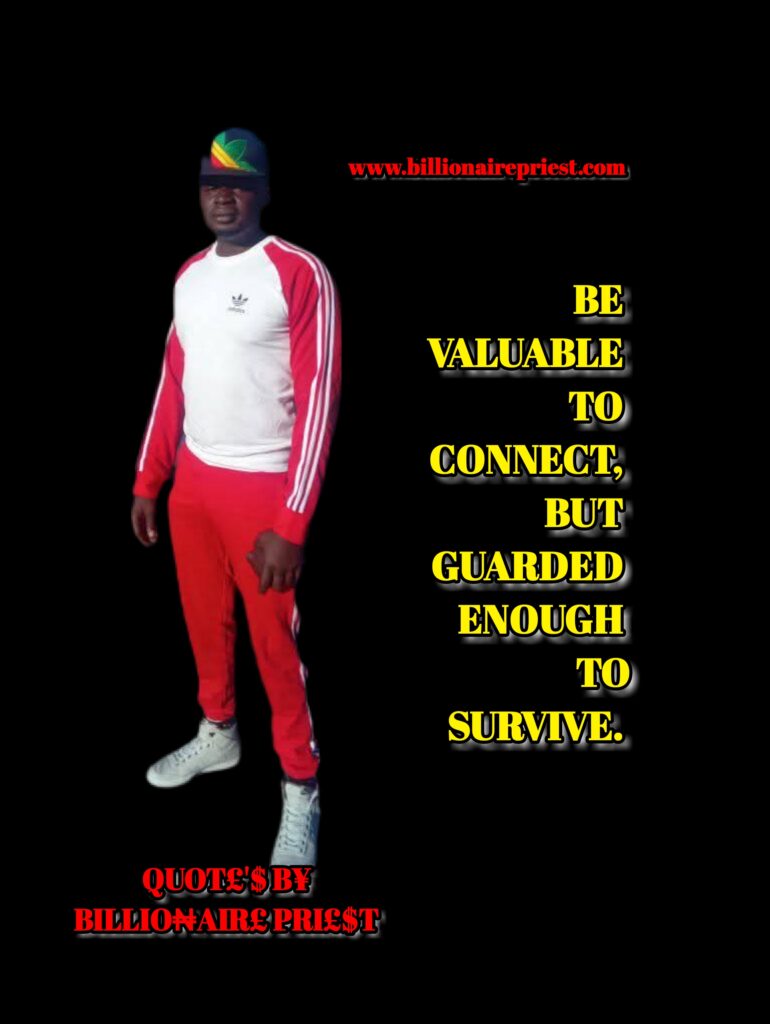












This line captures a powerful life principle.