 LUPER
LUPER
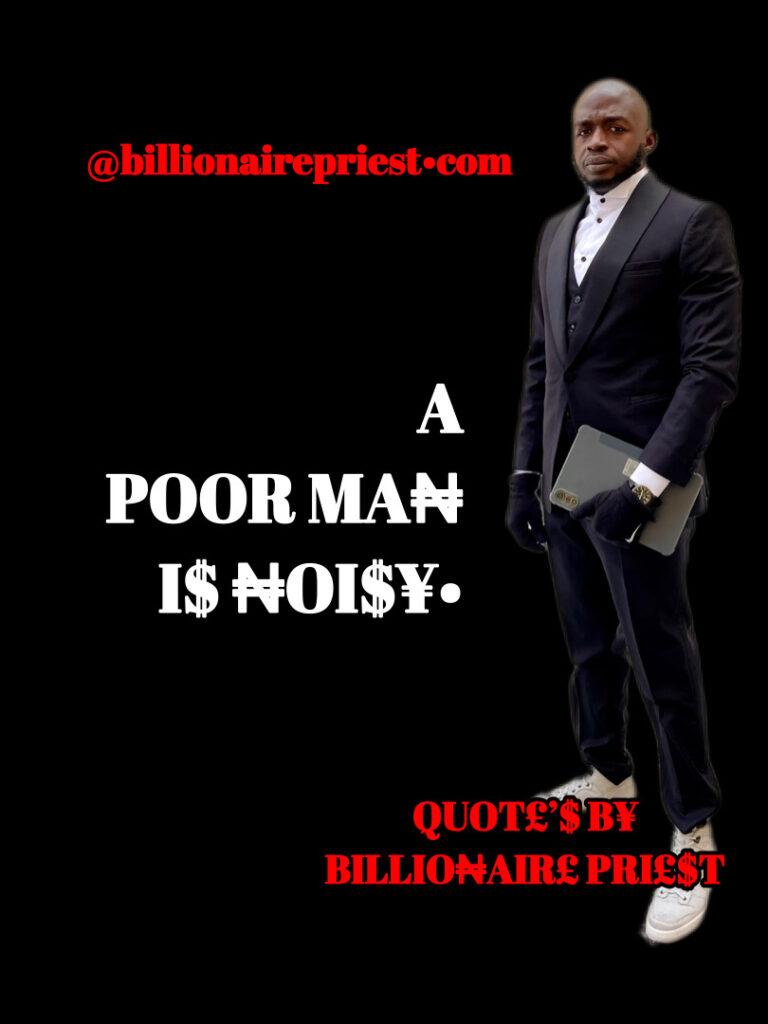
The statement “A poor man is noisy” is provocative. Taken literally, it is false and unfair. Poverty does not determine character. But as a metaphor, it points to something psychological and structural about insecurity, scarcity, and signaling.
To understand it deeply, we must interpret “poor” not only as financially lacking, but as operating from scarcity — material, emotional, intellectual, or social.
1. Scarcity Amplifies Signaling
When resources are limited, visibility becomes survival.
Behavioral economist Sendhil Mullainathan, in his work on scarcity, shows that lack consumes mental bandwidth. When you have little, everything feels urgent.
Scarcity creates pressure.
Pressure creates noise.
Noise can look like:
- Talking more than listening
- Reacting quickly
- Defending status aggressively
- Broadcasting minor achievements
- Arguing for recognition
It is not about income.
It is about insecurity.
2. Noise as Compensation
When someone lacks stable status or power, they may compensate through volume.
Psychologically:
- If you feel unseen → you amplify yourself.
- If you feel small → you exaggerate presence.
- If you feel insecure → you assert dominance verbally.
This is not cruelty; it is defense.
Quiet confidence usually comes from internal stability.
Instability seeks reassurance through attention.
3. Wealth and Silence
In contrast, those with stable power often speak less.
Why?
Because they do not need to:
- Prove competence
- Assert relevance
- Defend identity constantly
Their position is structurally reinforced.
Sociologist Pierre Bourdieu discussed different forms of capital — economic, social, cultural. Those rich in capital often signal subtly. Their confidence is embedded in posture, networks, and access.
They can afford silence.
4. The Economics of Attention
In many environments, especially competitive ones, noise is a strategy.
If you lack:
- Wealth
- Institutional authority
- Established reputation
Then attention may be your only leverage.
Social media amplifies this dynamic:
When material capital is low, attention becomes currency.
And attention is often captured through volume, controversy, or constant expression.
Noise is sometimes an attempt to manufacture value.
5. Emotional Poverty
The phrase can also refer to emotional poverty.
A person poor in:
- Patience
- Self-control
- Discipline
- Perspective
Often reacts loudly.
Impulsivity is noisy.
Restraint is quiet.
The person who interrupts, argues reflexively, or escalates minor conflicts is often protecting a fragile ego.
6. The Stability Principle
Silence is easier when:
- Your position is secure.
- Your resources are stable.
- Your identity is internally grounded.
- Your future feels protected.
When survival feels uncertain, urgency replaces composure.
This is why scarcity environments — not individuals — often appear chaotic. The noise is systemic.
7. The Danger of Misinterpretation
This statement becomes harmful if interpreted as:
“Poor people are inferior.”
That is shallow and inaccurate.
The deeper reading is:
Scarcity — in any form — creates reactive behavior.
A wealthy person in emotional scarcity can be just as noisy.
A financially poor person with internal discipline can be profoundly calm.
The variable is not money.
It is insecurity.
8. Power and Energy Conservation
Real power conserves energy.
Predators in nature are often still before decisive action.
Leaders who know their authority don’t rush to assert it.
When someone must constantly assert themselves, it often signals that authority is unstable.
Noise can be an attempt to create weight without substance.
9. The Deeper Psychological Truth
Noise is often a plea:
- “See me.”
- “Respect me.”
- “Validate me.”
- “Do not dismiss me.”
Scarcity makes invisibility terrifying.
Silence, by contrast, requires faith — faith in one’s competence, position, or eventual recognition.
10. The Refined Interpretation
“A poor man is noisy” can be understood as:
- Scarcity breeds urgency.
- Insecurity breeds overexpression.
- Lack of stable capital (economic or psychological) increases signaling behavior.
- True stability requires less performance.
But the highest insight is this:
Wealth is not quiet because it is superior.
It is quiet because it is secure.